Content is everywhere. Your audience scrolls through thousands of posts, emails, videos and ads every day. Most of it is ignored within seconds.
The problem isn’t a lack of content; the problem is unfocused content.
Many brands create educational posts but never prove results. Others try to build community but fail to demonstrate expertise. Some push testimonials without first establishing credibility. The result is scattered messaging, it might attract attention but it rarely converts.
If your content strategy feels chaotic, you aren’t lacking effort.
You’re lacking a system.
That system is The ACE Method.
What is the ACE Method?
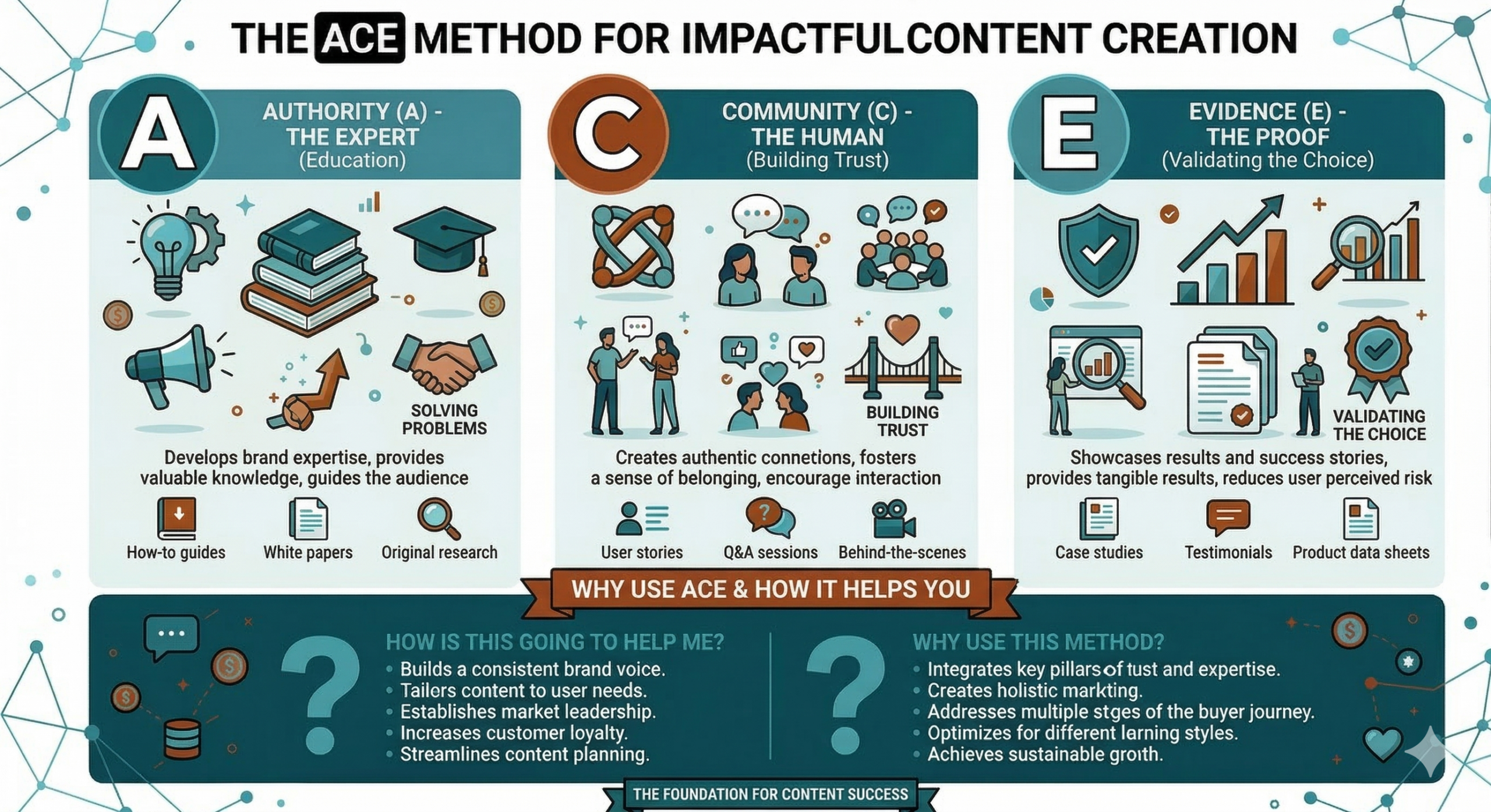
The ACE Method is a structured framework for creating balanced, high-impact content that builds trust and drives action. It ensures your content educates, connects, and proves value, all at the same time. It is a visual representation of how to build a complete trust ecosystem.
Why the ACE Method Works (and How it Helps You)
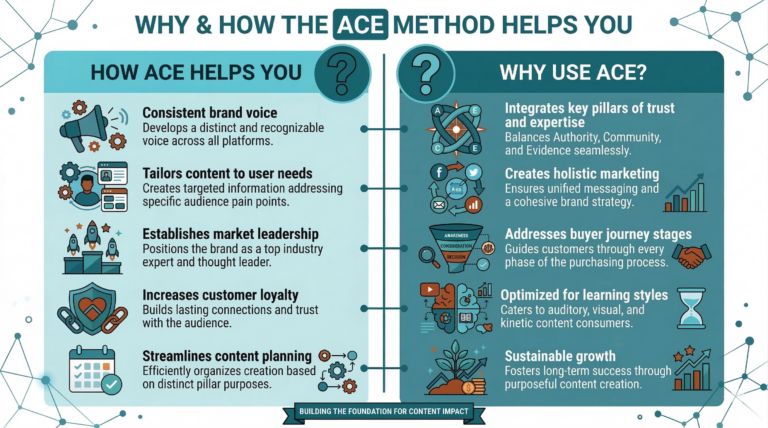
You might be asking: How is this actually going to move the needle for me? and Why use this specific structure instead of just posting whatever feels right that day?
The ACE Method succeeds because it aligns with how people naturally build trust. It moves beyond random acts of content and creates a unified story. When applied consistently, the ACE framework delivers critical business benefits:
- Creates a Clear and Consistent Brand Voice: Every piece of content, from social posts to deep-dive case studies, has a defined purpose and feels like it comes from the same trusted leader.
- Makes Content More Relevant: It forces you to look at problems through your user’s perspective, tailoring your messaging to their specific needs at different stages.
- Streamlines Brainstorming and Planning: The ACE framework simplifies your content planning process by giving every piece of content a specific job before you start creating.
The ACE Method isn’t just for major campaigns; it’s a filter for everything you create, optimizing for sustainable growth. Let’s break down the definitions of each pillar.
Pillar 1: Authority (A) — The Expert
Education That Solves Real Problems
The Authority pillar positions your brand as a knowledgeable guide. Your audience is constantly searching for answers, and authority content provides them.
True authority isn’t about showing off. It’s about teaching clearly. When you solve a problem for someone for free, you become the resource they return to when they are ready to pay.
- The Goal: Simplify complex topics and guide your audience toward better decisions.
- Examples: How-to guides, original research, white papers, and educational "explainer" videos.
- The Result: You move from being "just another option" to being the trusted leader.
Pillar 2: Community (C) — The Human Connection
Building Relationships That Last
Even in B2B industries, people do business with people they like. Community content is where your brand becomes human, relatable, and approachable. This is essential for long-term customer loyalty and earning user trust.
This pillar is often overlooked because it doesn’t always produce an immediate “Buy Now” click. However, it is the secret sauce for retention. It creates authentic connections and a sense of belonging that turns customers into advocates.
- The Goal: Build authentic connections and encourage two-way conversation.
- Examples: User stories, Q&A sessions, behind-the-scenes glimpses, and team spotlights.
- The Result: You turn an anonymous audience into a loyal following.
Pillar 3: Evidence (E) — The Proof
Eliminating the Shadow of Doubt
You can claim expertise and build relationships, but skeptical buyers will always ask one critical question: “Does it actually work?”
Evidence content answers that question with data. It reduces the perceived risk of a purchase and validates the user’s choice to work with you. It provides tangible results.
- The Goal: Replace vague claims with hard data and real-world validation.
- Examples: Case studies, verified testimonials, before-and-after results, and product data sheets.
- The Result: You move the prospect from interested to committed.
Moving from Theory to Strategy
The definitions make sense. But how do you apply this? How do you know if you are posting too much authority or not enough evidence?
This is where true strategy is required. For most businesses, an effective mix looks like this:
The ACE Content Strategy: The 60-30-10 Rule
This balanced ratio keeps your trust ecosystem functioning properly:
Tip! Evidence pieces (like deep-dive case studies) take more effort to produce, which is why they represent a smaller percentage. However, they often have the highest conversion impact.
- Authority (60%): This is your "top of funnel" engine. It keeps a steady stream of new eyes on your brand by teaching first.
- Community (30%): This deepens the relationship with the people who are already following you.
- Evidence (10%): This appears strategically to close the gap between interest and action.
Putting it the ACE Method into Practice
The ACE framework simplifies content planning by giving every post a specific job. Before you hit publish, ask: Is this teaching, connecting, or proving? This structure ensures your content strategy stays balanced and intentional.
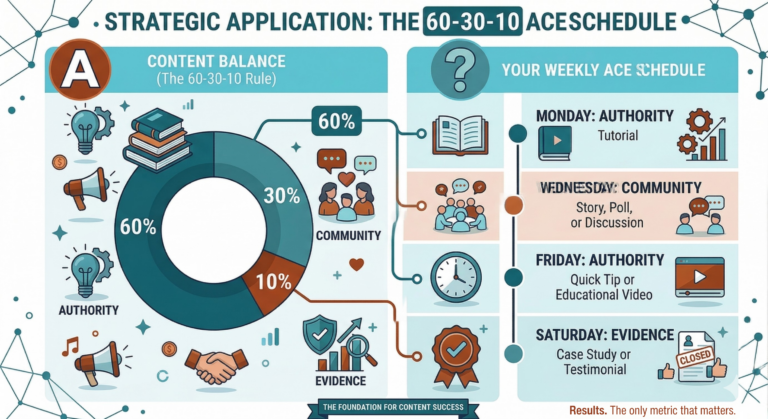
Your weekly schedule ensures that your content strategy isn’t just random acts of information, but a structured sequence designed to lead, connect, and validate.
The Bottom Line
Many brands produce a high volume of content but see a low return on investment. The problem isn’t your work ethic; it’s your structure.
Authority attracts. Community connects. Evidence convinces.
When these three pillars work together, your content stops being “noise” and starts becoming a strategic growth system. It’s time to stop creating content randomly.
It’s time to start creating like an ACE.

Get Started With Dot Marketing and Web Design
We look forward to visiting with you about your marketing ideas!